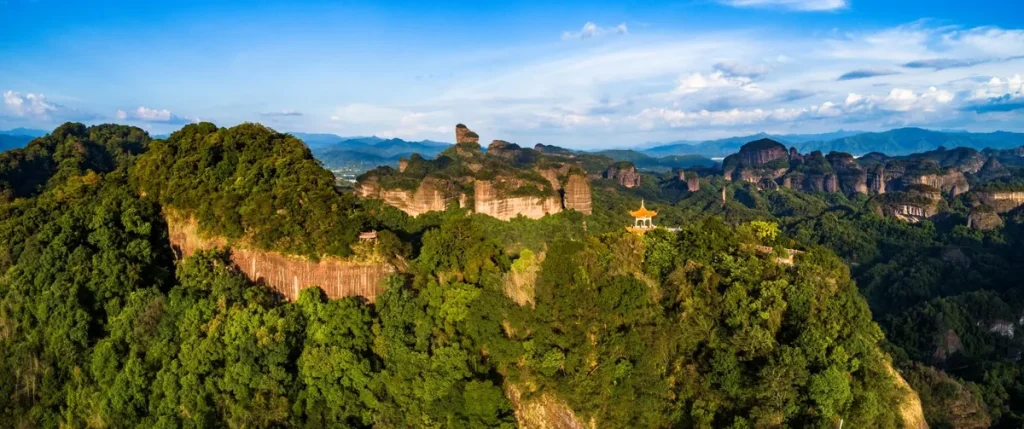
Just before sunrise, the Yao folk song rises through the mist: “Luokeng’s mountains are high, and the wild tea is plentiful.” Below, a sea of clouds rolls through the valleys of Qujiang District, Shaoguan, where a landscape shaped over millennia holds one of China’s most remarkable tea ecosystems — a forest that has never been planted, never been farmed, and never been tamed.
The Mountain That Gives the Tea Its Name
The story begins at Chuandiding (船底顶, “Ship-Bottom Peak”), a 1,586-meter mountain in the heart of the Luokeng region of northern Guangdong. Named for its distinctive inverted-boat silhouette, Chuandiding is the highest peak of Qujiang District, the second-highest in all of Guangdong, and the only mountain in the province selected by China National Geographic for its 2009 list of “China’s Top Ten Non-Famous Mountains” — peaks of exceptional natural significance that remain outside the tourist circuits.
Surrounded by more than thirty peaks above 1,000 meters — including Snow Flower Peak (雪花顶, 1,315m) — Chuandiding anchors a 30,000-hectare nature reserve that is one of Guangdong’s last untouched wildernesses. Its forests, with canopy cover exceeding 86%, shelter the Luokeng Crocodile Lizard National Nature Reserve and contain one of only two inland marsh wetlands remaining in the province. This is not a tea garden. It is a living, breathing ecosystem that has sustained itself for thousands of years without human intervention.
Tea Roots That Go Back Twelve Centuries
Luokeng is not a new discovery on the tea map. Its tea history reaches back more than 1,200 years, to a time when Luokeng was already recognized as a core tea-producing area of what was then called Shaozhou — present-day Shaoguan.
The earliest documented recognition comes from Lu Yu (733–804 AD), the Tang Dynasty sage whose Classic of Tea (《茶经》) is the foundational text of tea culture worldwide. In Chapter Eight, Lu Yu writes: “The tea of Lingnan grows in Fuzhou, Jianzhou, Shaozhou, and Xiangzhou — and when found, its flavor is excellent” (岭南生福州、建州、韶州、象州,往往得之,其味极佳). Shaozhou, the ancient name for Shaoguan, was listed among only four prefectures in all of Lingnan (south of the Nanling Mountains) that produced tea worthy of mention. This is the first recorded acknowledgment of Shaoguan’s tea — and it was written before most of the world’s famous tea regions had any written history at all.
More than a millennium later, the Qing Dynasty official record confirms the continuity. The Shaozhou Prefecture Gazetteer (光绪版《韶州府志》) and Qujiang County Gazetteer (《曲江县志》) from the Guangxu period (1875–1908) document: “The tea of Luokeng is red in color and rich in flavor; it remains unchanged overnight and is particularly effective in relieving summer heat.” The same description — a red tea of remarkable quality — holds true for what Chuandiding’s wild ancient trees produce today.
From the Tang Dynasty to the Qing Dynasty to the present, Luokeng’s tea has been recognized across thirteen centuries of written record — a lineage that places it among the most historically documented tea origins in China.
Forty Thousand Ancient Trees, Scattered Across a Mountain
The tea trees of Chuandiding are not planted. They are wild ancient trees — seeds that fell centuries ago, took root in the acidic mountain soil, and grew untouched in the misty subtropical forest. Surveys have identified more than 40,000 ancient tea trees over a century old across the Luokeng reserve, with the oldest estimated at 800 to 1,000 years of age.
These trees are fundamentally different from the low bushes of plantation tea. They are gushu — ancient arboreal tea trees that grow to 5–8 meters tall, with trunks too thick to encircle with both arms, their branches draped in moss and lichen that testify to centuries of undisturbed growth. Their root systems reach deep into mineral-rich bedrock, accessing nutrients that no cultivated bush can reach. Unlike plantation tea, which is harvested multiple times per season, Chuandiding’s ancient trees produce one flush per year — a single harvest that concentrates the tree’s energy into a smaller quantity of leaves with correspondingly denser aromatic compounds.
Most tea in the world comes from waist-high bushes pruned for easy plucking. A wild ancient tree cannot be planted, cannot be replicated, and cannot be scaled. Each tree exists only where nature put it, scattered across the mountain’s steep slopes and accessible only on foot. This is absolute scarcity baked into the landscape itself.
The Three-Hour Trek to Reach Them
The journey to the Chuandiding tea trees is not a walk. The Yao pickers leave before dawn, passing through dense bamboo groves, crossing streams over slippery rocks, and climbing steadily into the cloud layer. The trail is not a path; it is the forest floor itself, marked only by the knowledge of those who have walked it for generations. By the time they reach the first trees, three hours have passed.
A tea picker at a standard plantation can harvest 20–30 kilograms of fresh leaves in a day. Here, the journey alone consumes the morning. The harvest window is short, the access is hard, and every gram of leaf carries the weight of the hike that delivered it.
The People Who Have Lived Alongside These Trees for Generations
The Yao ethnic minority (瑶族) have inhabited the mountains of northern Guangdong for centuries. In the video, the pickers wear traditional dark indigo clothing with red and white embroidery — a visual language that identifies their heritage. The folk song that opens the video is a Yao mountain song: “We get up early to pick tea.” Another line translates: “We go to Chuandiding to pick ancient tree tea today.”
The Yao people’s knowledge of these mountains — which trees produce the best leaves, when exactly to harvest, how to climb without damaging the branches — is not taught in any school. It is inherited across generations, as the trees themselves are inherited. Every leaf gathered from Chuandiding carries not just the mountain’s character but the accumulated wisdom of people who have lived alongside these ancient trees for as many generations as the trees have stood.
The video ends with a line across the screen: “Returning from tea-picking, the crescent moon hangs halfway.” They started before dawn and returned after dusk. That is what the forest demands — and what makes every leaf from Chuandiding worth understanding.
This remarkable ecosystem gives life to two Legend-grade teas, each a different expression of the same ancient forest. Their own stories deserve their own pages — and you will find them linked below.