Luokeng — Sanctuary of Ancient Tea Trees
A Hidden Valley in Southern China
Deep within the Nanling mountain range of northern Guangdong lies a place that tea connoisseurs speak of in reverent tones: **Luokeng** (罗坑). Located in Qujiang District, Shaoguan City, this 18,813-hectare provincial nature reserve is one of the most significant repositories of wild ancient tea trees in all of China — and arguably the world.
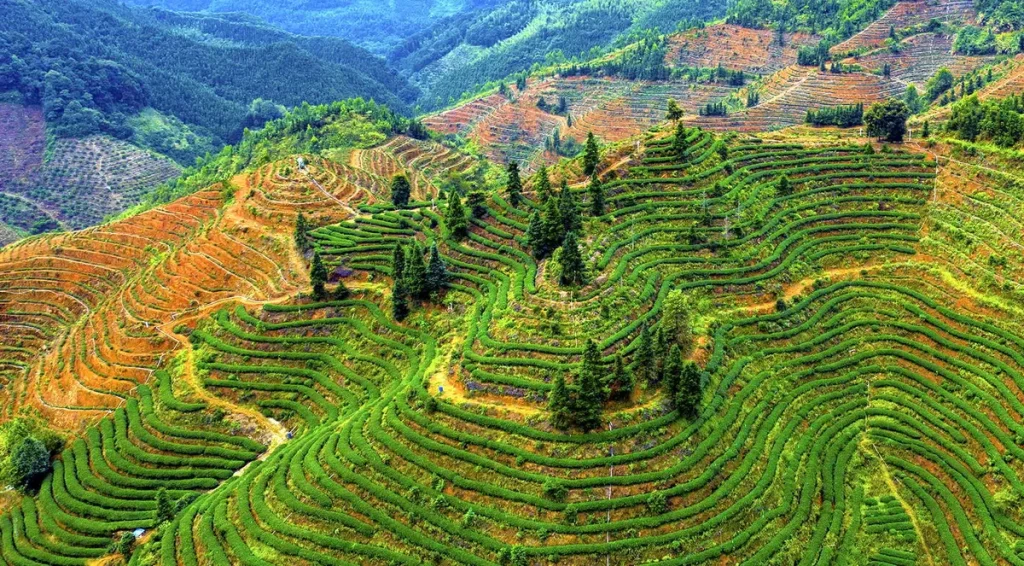
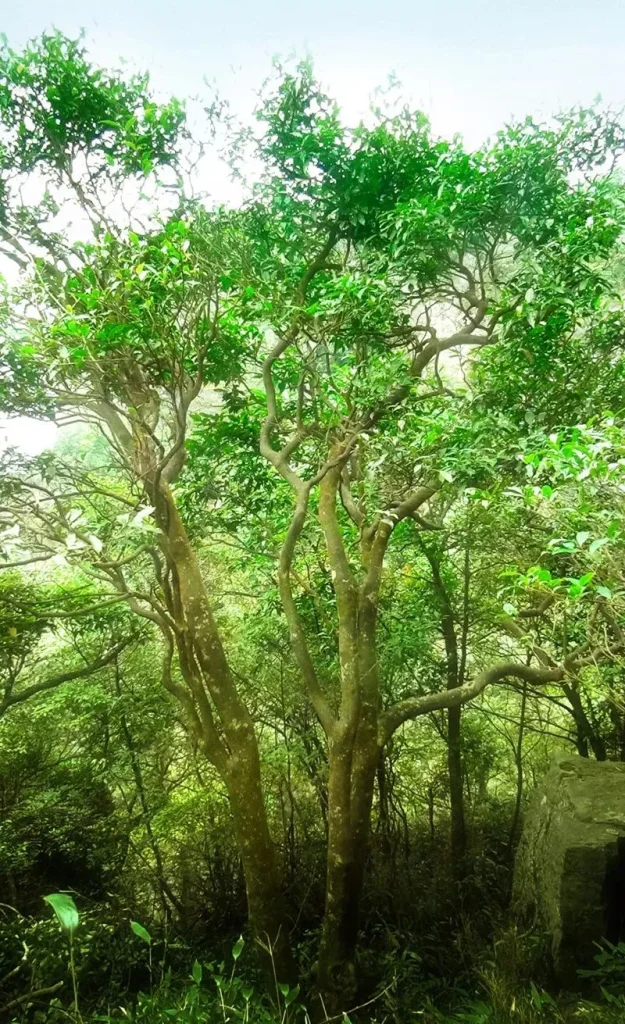
Unlike the manicured, terraced tea gardens seen on Instagram and tea packaging, Luokeng is raw, untamed, and ancient. Its steep valleys — some dropping 800 vertical meters from ridge to stream — dense subtropical forests, and year-round mists have preserved a living botanical archive: over **40,000 wild ancient tea trees**, some estimated to be more than **800 years old**. These are not cultivated bushes trimmed to waist height for easy plucking. They are tea trees (Camellia sinensis var. assamica-like wild stock) that have grown, seeded, evolved, and competed in natural forest conditions for centuries, completely untouched by modern agricultural practices. Many stand 5 to 12 meters tall with trunks 30–60 cm in diameter — dimensions that reveal their true age and wild heritage.
The reserve’s inaccessibility has been its salvation. Until recently, Luokeng was known only to local Yao villagers, a handful of botanists, and the most intrepid tea hunters. There are no paved roads into the core tea-tree areas. The nearest town of any size is 30 km of winding mountain road away. This isolation kept Luokeng — and its 40,000 ancient trees — safe from the large-scale development that transformed other tea regions during China’s economic boom.
40,000 Ancient Tea Trees
The ancient tea trees of Luokeng are scattered across elevations between 500 and 1,200 meters, growing in scattered stands rather than uniform plantations. They range from younger specimens a few meters tall to towering ancients over 10 meters high — a reminder that tea, left to its own devices, grows into a substantial tree, not a waist-high bush.
Why does age matter so dramatically in tea? The answer lies underground and in the leaves themselves. Ancient tea trees develop root systems that extend 5–15 meters deep — sometimes deeper than the tree is tall — tapping into mineral-rich subsoil layers completely inaccessible to the shallow-rooted cultivated bushes grown in commercial tea gardens. These deep roots draw up a wider spectrum of trace minerals: zinc, manganese, selenium, and rare earth elements that subtly influence flavor. The same minerals that make wine from old-vine vineyards more complex do the same for ancient-tree tea.
The chemical differences are measurable. Studies of ancient tea tree leaves (Camellia sinensis var. assamica) from the Nanling region show:
- **30–40% lower concentrations** of bitter catechins (specifically epigallocatechin gallate, or EGCG) compared to modern cultivated varieties
- **15–25% higher L-theanine** content — the amino acid responsible for tea’s calming, “zen-like” effect and umami sweetness
- **Thicker leaf cuticles** with higher wax content, which protect against pests naturally and slow down moisture loss during processing
- **Greater diversity of volatile aromatic compounds** — the chemicals that become aroma — likely due to the tree’s longer life and exposure to more varied environmental conditions
The oldest trees in Luokeng are believed to be **800+ years old**, dating to the Song Dynasty (960–1279 AD) or even earlier. Dendrochronological assessment of trunk girth and growth rings, combined with historical records from local Yao genealogies, supports this age estimate. These ancient sentinels have survived Mongol invasions, Ming and Qing dynastic transitions, civil wars, the rapid industrialization of 20th-century China, and the relentless expansion of agriculture. Their continued existence is nothing short of a botanical treasure.
Harvesting from these trees is a delicate, labor-intensive operation. Workers climb the tall trunks using ladders or by scrambling up branches, picking only the tenderest spring buds and first two or three leaves from the upper canopy where sunlight exposure produces the best flavor development. A single large tree may yield only 500 grams to 1 kilogram of finished tea per year — scarcity that explains why Luokeng ancient tree teas command prices 5–10 times higher than standard garden teas among serious collectors. The picking season is short, typically 2–3 weeks in late March to mid-April, depending on elevation and spring weather.
The Unique Ecosystem
Luokeng is not just a tea sanctuary — it is officially designated a **Crocodile Lizard National Nature Reserve**, one of only a handful of places on earth where the endangered Chinese crocodile lizard (Shinisaurus crocodilurus) still survives in its native wild habitat. This living fossil reptile, which has remained virtually unchanged for millions of years, shares its pristine mountain stream habitats with the ancient tea trees. Both species are protected by the same remote, forested environment — a powerful testament to the ecological integrity of Luokeng.
The biodiversity statistics, compiled in recent surveys by the Guangdong Academy of Sciences, are staggering for a region of its size:
- **1,464 vascular plant species**, including 28 rare and endangered orchid species, dozens of medicinal herbs used in Traditional Chinese Medicine, and of course the ancient tea trees
- **301+ vertebrate species**, including clouded leopards (Neofelis nebulosa), masked palm civets, Chinese pangolins, and over 200 recorded bird species including silver pheasants and crested serpent eagles
- **28 nationally protected animal species** under Chinese wildlife protection laws
- **Unsurveyed populations** of invertebrates, fungi, and microorganisms likely push the total species count into the tens of thousands
This biodiversity is not incidental — it is functional. Luokeng’s elevation range of 200–1,400 meters produces distinct vertical vegetation zones, from subtropical evergreen broadleaf forest at lower elevations to mixed coniferous-broadleaf forest above 800 meters. Annual rainfall exceeds 1,800 mm, distributed across a distinct wet season (April–September) and dry season, with the frequent mists and fog that high-forest tea regions are famous for.
The practical consequence for tea quality: because the tea trees grow interspersed with native forest — bamboo groves, ancient pines, flowering gardenia, wild orchids, camphor trees — rather than in monoculture plantations, the leaves develop flavors literally influenced by their botanical neighbors. Volatile organic compounds released by surrounding vegetation are absorbed by the waxy leaf cuticles of the tea trees. This phenomenon, called “environmental aroma transfer,” is well documented in wine grapes growing near eucalyptus or rosemary, and it applies equally to tea. No plantation tea garden, no matter how carefully managed, can replicate this complexity. The intercropping is natural, not designed — a forest ecosystem that has been working for millennia.
The People of Luokeng
The stewards of Luokeng’s ancient trees are the **Yao ethnic minority** (瑶族), an indigenous people who have inhabited these Nanling mountains for over a thousand years. The Yao — one of China’s 56 officially recognized ethnic groups — have their own language (a Hmong-Mien language distinct from Chinese), distinctive silver jewelry and indigo-dyed embroidery traditions, and an intimate, multigenerational relationship with the forest that surrounds them.
For the Yao, tea is not merely a cash crop — it is woven into daily life, cultural ritual, and intergenerational knowledge. Yao families have harvested wild tea leaves from the same trees, generation after generation, using methods that prioritize long-term sustainability over short-term yield. Their traditional harvesting rules are strict and ecologically sound:
- **Never take more than 60–70%** of a tree’s spring flush — leave enough for the tree’s own growth and for wildlife
- **Never cut down trees** or clear forest to expand tea-growing areas
- **Never use chemicals** — the forest provides natural pest control, and the Yao have no tradition of agricultural chemicals
- **Rotate harvesting** among different trees and slopes to prevent over-stressing individual specimens
This stewardship, born of cultural tradition rather than any external certification program, has preserved Luokeng’s tea ecosystem in near-pristine condition while many other Chinese tea regions were converted to high-yield, chemically farmed plantations during the 1980s–2000s.
Today, many Yao villagers work with Shaoguan tea companies through partnership agreements that establish sustainable harvest limits, provide fair pricing (typically 2–3 times the local market rate for standard tea leaf), fund community infrastructure like clean water and school supplies, and support the preservation of Yao language and cultural practices. These partnerships help keep the Yao community economically viable in their remote mountain homes, reducing the pressure on younger generations to abandon traditional livelihoods for factory work in distant cities.
A Legacy Protected by Nature
Luokeng’s isolation is its greatest asset and its most powerful marketing message. The reserve has no factories, no chemical-intensive agriculture, no major roads. In many areas, the only way to reach the tea trees is by foot — a two-to-three-hour hike up narrow mountain trails, often through persistent fog and across streams. Cell reception is sporadic at best.
This natural protection means that **organic is not a certification choice in Luokeng — it is the only possible way to farm**. No chemical inputs have ever been used on these trees because no chemical inputs have ever been brought here. The forest’s altitude, steep terrain, and native biodiversity make chemical farming logistically impossible and ecologically nonsensical. The trees thrive without human intervention — in fact, they thrive in spite of it, producing some of the most sought-after tea in China with virtually no agricultural inputs whatsoever.
Production is inherently limited. Luokeng’s ancient trees produce one meaningful harvest per year (spring), with a very small second flush in summer for some trees. Total annual production of Luokeng ancient tree tea is estimated at 20–30 tons — a fraction of what a single mid-size plantation tea garden produces. Each harvest is an event, tracked by collectors who follow the season reports like wine enthusiasts follow Bordeaux en primeur.
For the tea drinker, Luokeng offers something increasingly rare: a direct link to tea as nature intended it — wild, genetically diverse, ancient, and unimproved by human selection. The flavor profile of Luokeng ancient tree black tea is unlike any cultivated tea: deeper, slower to release its character, and changing perceptibly from infusion to infusion. A single gongfu session can reveal, in sequence, notes of wild honey, dried longan, orchid, pine resin, and a cooling, almost minty finish. The mouthfeel is thick and coating — what Chinese tea drinkers call “yun” — with a sweetness that persists for minutes after swallowing.
Explore Shaoguan Tea from Luokeng
For those seeking to taste Luokeng’s wild heritage directly, the Snow Flower Rock — Premium Ancient Tree Black Tea is the definitive expression of this terroir. Harvested from wild ancient trees at 800–1,000 meters elevation in the Luokeng Nature Reserve, this black tea captures the full depth — mineral backbone, almond-like complexity, wild honey sweetness — that only centuries-old trees growing in primary forest can produce.
To explore the full range of teas from this remarkable region — including white, black, and oolong teas sourced from both ancient wild trees and heirloom cultivated varieties — visit Shaoguan Tea and discover why Luokeng is increasingly recognized as one of the world’s last great sanctuaries of wild tea.