Lechang — Where Mountain Mist Shapes a Unique Black Tea
**Lechang (乐昌市)** occupies the northwestern corner of Shaoguan, a county-level city where 72% of the terrain is mountainous. Here, on the slopes of the Nanling range, tea has been cultivated for centuries — and in 1965, the **Lechang Baimao** tea variety became one of the first officially recognized improved tea cultivars in the People’s Republic of China.
At a Glance
| Detail | Value |
|---|
|——–|——-|
| **Location** | Northwestern Shaoguan, bordering Hunan province |
|---|---|
| **Area** | 2,419 km² |
| **Population** | ~516,900 (urban ~375,500) |
| **Terrain** | 72% mountains, 13.5% hills, 14.5% river valleys |
| **Tea-Growing Elevation** | 400–800 m |
| **Average Temperature** | ~20°C |
| **Annual Rainfall** | 2,166 mm |
| **Forest Cover** | 70.9% |
| **Signature Tea** | Lechang Baimaojian Black Tea (白毛尖红茶) |
| **GI Product** | Yanxishan Baimaojian (沿溪山白毛尖) |
| **Key Cultivar** | Lechang Baimao Tea — nationally recognized since 1965 |
| **Key Producer** | Lechang Yanxishan Tea Farm (乐昌市沿溪山茶场有限公司) |
Geography & Terroir
Lechang covers 2,419 km² at the intersection of the **Nanling mountain range** and the **Beijiang River basin**, bordering Hunan province to the northwest. With 72% of its territory classified as mountainous, Lechang is the most topographically dramatic of Shaoguan’s tea districts. Only 14.5% of the land is river valley.
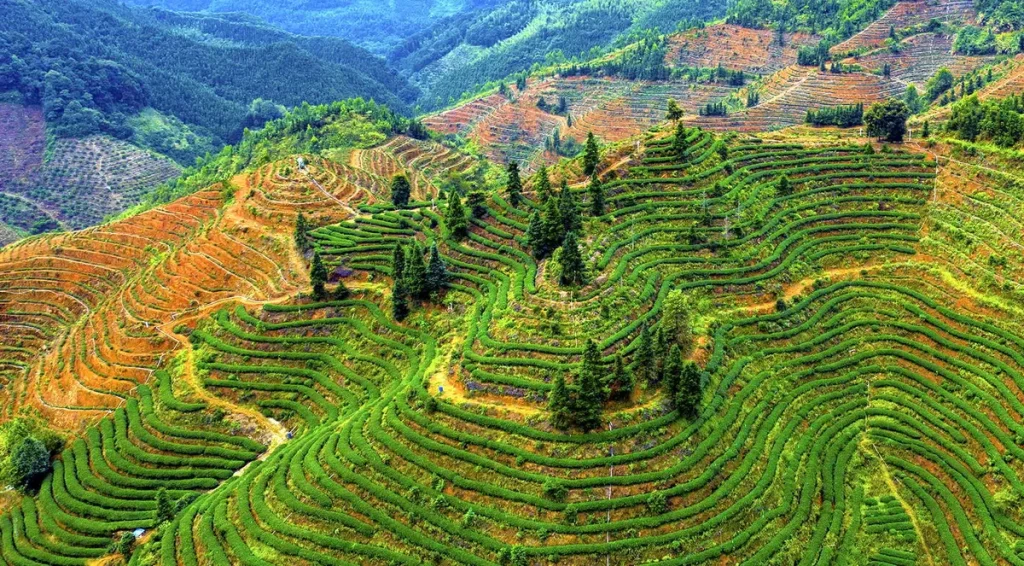
The county’s tea heartland is the **Jiufeng Mountain range (九峰山)**, a series of forested peaks that catch moisture-bearing winds from the south. The most famous tea-growing area within this range is **Yanxishan (沿溪山)** — literally “along the creek mountain” — where tea gardens line the numerous streams that descend from the peaks.
The dominant soil type is **weathered red-yellow earth** derived from granite and sandstone bedrock. This well-draining, slightly acidic soil (pH 4.5–6.0) is rich in iron, aluminum, and trace elements — a mineral composition that gives Lechang teas their characteristic **briskness and clean mineral finish**. The bright amber-red liquor of a well-made Lechang black tea is a direct expression of this soil chemistry.
Two climatic factors set Lechang apart from neighboring tea districts:
1. **Greater rainfall**: At 2,166 mm annually, Lechang receives more rain than any other Shaoguan tea county except Qujiang. This, combined with frequent mountain fog, creates slow-growing conditions that concentrate flavor compounds.
2. **Temperature variation**: The mountain terrain creates significant diurnal temperature swings — cool nights followed by warm days — which local tea growers consider essential for developing the tea’s aromatic complexity.
Tea Heritage: The Baimao Legacy
Lechang’s tea story is defined by the **Lechang Baimao (乐昌白毛)** variety — one of China’s first officially recognized improved tea cultivars.
A National Tea Variety
In **1965**, Lechang Baimao tea was designated one of China’s first nationally approved improved tea varieties — a list that included only the most distinctive and high-quality regional cultivars. The variety was promoted nationwide, with cuttings sent to Fujian, Hunan, Jiangxi, Sichuan, and Anhui provinces for propagation. In **1985**, the Ministry of Agriculture and Fisheries formally certified Lechang Baimao tea as a national improved variety, cementing its status as one of China’s foundational tea cultivars.
Three Sub-Types
The Lechang Baimao population encompasses three distinct sub-types:
| Variant | Leaf Type | Characteristics |
|---|
|———|———–|—————-|
| **Da Ye Baimao (大叶白毛)** | Large-leaf | Bold flavor, high yield, full body |
|---|---|---|
| **Jian Ye Baimao (尖叶白毛)** | Pointed-leaf | More aromatic, finer trichomes, delicate profile |
| **Zhong Ye Baimao (中叶白毛)** | Medium-leaf | Balanced character, most versatile |
All three share the defining trait: **dense silvery-white trichomes** covering the young leaf buds — the “white hair” that gives Baimao tea its name. These trichomes are rich in amino acids, which contribute to the tea’s characteristic smooth mouthfeel and natural sweetness.
Yanxishan Baimaojian GI
In 2016, **Yanxishan Baimaojian (沿溪山白毛尖)** was granted **China Geographical Indication (GI) protection** under standard DB44/T 1900-2016. The GI covers the traditional production zone within the Jiufeng Mountain range of Lechang, specifying:
- **Raw material**: Yanxishan Baimao tea cultivar (small arbor type, medium-leaf)
- **Growing conditions**: 250–1,200 m elevation, well-drained acidic soils
- **Tea type**: Green tea with silvery downy buds
Signature Teas
Lechang Baimaojian Black Tea
Lechang’s most renowned export is **Baimaojian Black Tea (白毛尖红茶)**. While the GI primarily covers green tea, the black tea version has become more popular internationally. The silvery downy buds — rich in amino acids — produce a smooth, sweet cup with less astringency than typical black teas.
**Flavor profile**: Malty depth with floral aftertaste. Notes of dried longan and wild honey. Bright amber-red liquor. Smooth, silky mouthfeel from the high trichome density. A clean, mineral finish that lingers.
Yanxishan Green Tea
The traditional green tea style emphasizes:
- Gentle withering to preserve the leaf’s natural compounds
- Light kill-green (fixation) at controlled temperatures
- Careful hand-rolling to shape the leaves without damaging the downy tips
- Low-temperature drying to preserve the fresh, floral character
**Flavor profile**: Jade-clear cup, fresh and floral, with a clean, sweet finish. The distinctive “white hair” mouthfeel — soft and silky — from the high trichome density.
Jiufeng Mountain Scenery
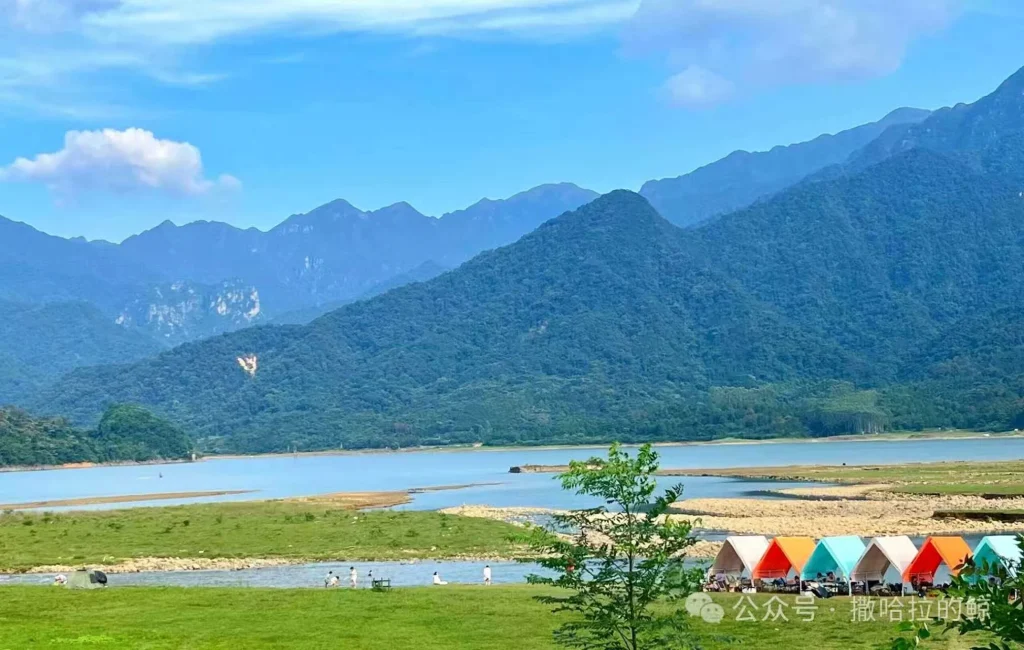
**Jiufeng Mountain (九峰山)**, the dramatic peak that dominates the Yanxishan skyline, is both a scenic landmark and a source of Lechang’s terroir identity. The mountain’s granite cliffs and dense forest cover create localized weather patterns — morning mist lingers in the tea gardens until mid-day, providing natural shade that preserves tenderness in the young leaves. This misty microclimate, visible in panoramic views from Jiufeng’s slopes, is the defining feature of Yanxishan’s tea terroir.
The area is also known for its **spring peach blossom festival**, when the mountain slopes are covered in pink and white blossoms. This orchard-and-tea landscape creates a distinctive agricultural aesthetic that draws visitors from across Guangdong.
Local Culture
Lechang’s cultural landscape is shaped by its position as a **mountain gateway** between Guangdong and Hunan. The county has been a transportation corridor for centuries — the ancient Mei Pass trading route passed through these mountains, and the modern Beijing-Guangzhou high-speed railway follows a similar path.
Lechang’s population is a mix of **Cantonese and Hakka** dialect speakers, reflecting its position at the cultural boundary between the Pearl River delta and the interior. This mixing is evident in local food and tea culture, which borrows from both Cantonese refinement and Hunanese boldness.
The **Jiufeng Mountain peach blossom festival** in spring is Lechang’s biggest cultural event. The combination of blooming orchards, misty tea gardens, and traditional mountain village life creates a tourist draw that supports the local tea economy.
Notable Producers
Lechang Yanxishan Tea Farm (乐昌市沿溪山茶场有限公司)
The primary producer of Yanxishan Baimaojian and the lead drafter of the GI standard DB44/T 1900-2016. The farm has been operating in the Jiufeng Mountain range for decades, maintaining traditional processing methods while gradually expanding organic production.
Key facts:
- **Lead drafter**: DB44/T 1900-2016 Geographical Indication standard
- **Location**: Yanxishan, Jiufeng Mountain range, Lechang
- **Key people**: Huang Yanfei, Gao Wenfeng, Chen Shicong (standard drafting team)
- **Production**: Traditional green tea (Baimaojian) and black tea (Baimao Hongcha)
How to Brew Lechang Baimaojian
To get the most from Lechang’s Baimaojian black tea, pay attention to water temperature and steep time. The silvery downy buds are delicate despite the tea’s full body:
**Gongfu method (recommended):** 4–5g leaf, 100ml gaiwan, 90–95°C (194–203°F). Rinse briefly (5s). First steep: 15s. Add 5–10s per subsequent steep. Expect 6–8 infusions. The first 2–3 steeps highlight floral notes; steeps 4–6 reveal the malty depth and dried longan sweetness.
**Western method:** 2–3g leaf, 250ml mug, 95°C, 3–4 minutes. Expect two infusions — the second at 4–5 minutes will be mellower but equally satisfying.
**Pairing:** Lechang Baimaojian pairs exceptionally well with light desserts (almond cookies, honey cakes) and soft cheeses. Its malty depth also complements dark chocolate (70%+ cocoa).
Visiting Lechang
Lechang city center is approximately 40 kilometers northwest of Shaoguan on Highway G0423, with regular bus and high-speed rail connections. The Yanxishan tea-growing area and Jiufeng Mountain are a 30-minute drive from the city. The area has limited tourism infrastructure — visiting requires coordination with local tea farms or hiring a guide who knows the mountain roads.
The best time to visit for tea is late March to May (spring harvest) or September–October (autumn harvest). The Yanxishan Tea Farm accepts visitors by appointment during harvest season, offering garden walks and tasting sessions. Spring is also the peak of the peach blossom season, making it the ideal time for a combined tea-and-landscape visit.
Explore Shaoguan Tea
This article is part of a series exploring Shaoguan’s tea districts. Each district contributes a distinct character to the region’s tea culture. Lechang’s gift is the Baimaojian — a black tea that proves northern Guangdong’s high mountains can produce teas of world-class complexity and depth.
If you’re exploring the Lechang profile, the **Snow Flower Rock High Mountain Organic Black Tea** ($12) offers an affordable introduction to the bold, malty character of northern Guangdong black teas. For a premium experience, the **Snow Flower Rock Reserve Ancient Tree Black Tea** ($85) showcases the honey-sweet, floral dimension of the region’s high-mountain teas.
👉 **Browse all Shaoguan teas**