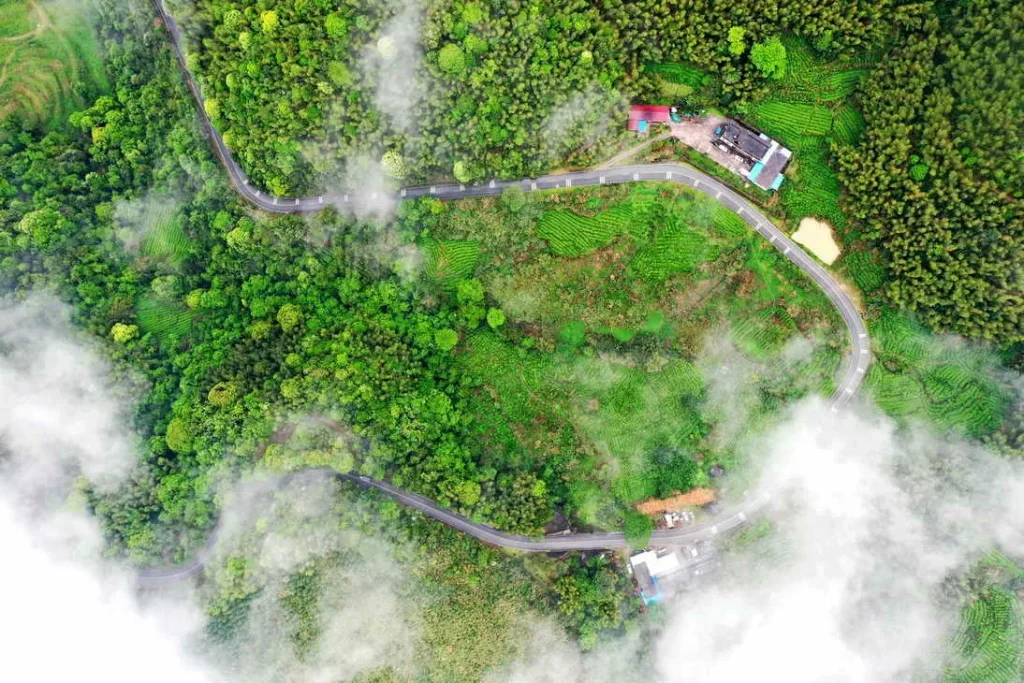
In the mountains of northern Guangdong, a scientist spent three sleepless nights looking at tea leaves. Chen Dong (陈栋), the national chief black tea expert of China’s Agriculture Research System, had just discovered something that, by all conventional logic, should not have existed — a black tea that carried a natural, unadulterated almond fragrance, produced by wild ancient trees growing in a nature reserve that most of the tea world had never heard of.
That discovery became the Snow Flower Rock Wild Ancient Tree Black Tea (Almond Aroma) — a tea so singular in its origin that it fills a gap in China’s black tea aroma spectrum. This is the story of that tea, the three ancient tree communities that can produce it, and the people who bring it from a remote mountain peak to your cup.
The Discovery That Rewrote the Rules
Around 2011, Chen Dong — then deputy director of the Guangdong Academy of Agricultural Sciences and the national post scientist for black tea — led a survey of Luokeng’s ancient tea tree populations. What he found defied expectation. Among the more than ten distinct ancient tree communities scattered across the Luokeng Nature Reserve, only three could produce tea with a natural almond fragrance. Four others produced a woody-sweet aroma. One produced a remarkable “bitter-then-sweet” profile.
The almond aroma, he realized, was not a flavoring. It was not a processing trick. It was the result of a specific genetic lineage of tea tree, growing in a specific microclimate on specific mineral-rich soil, processed using a technique that had to be invented from scratch. “I couldn’t sleep for three days,” Chen Dong later recalled. “I knew we had found something that filled a gap in China’s tea history.” That gap was the absence of a naturally fragrant almond-aroma black tea — a gap that had existed for as long as Chinese black tea had been produced.
Through years of research and trial production, Chen Dong’s team — working alongside Snow Flower Rock (Xuehuayan) — developed the proprietary processing technique that stabilizes and enhances the almond fragrance, transforming it from a rare natural phenomenon into a reproducible craft. The result was recognized as filling a genuine blank in China’s black tea aroma spectrum — a tea that had no predecessor.
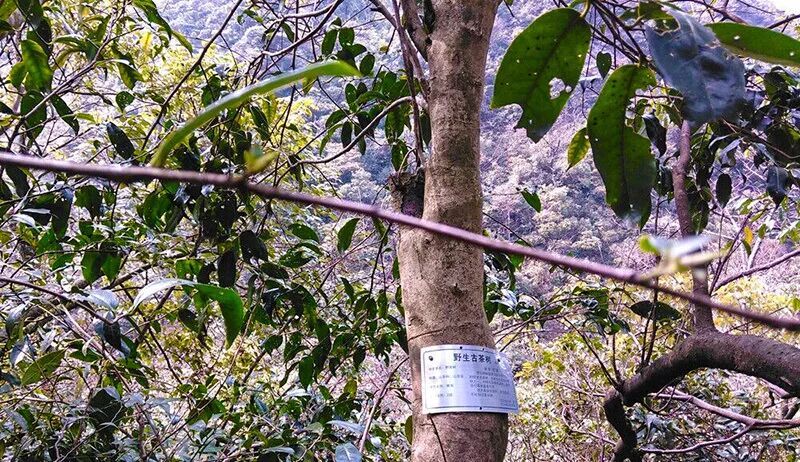
The Mountain That Made the Tree Exceptional
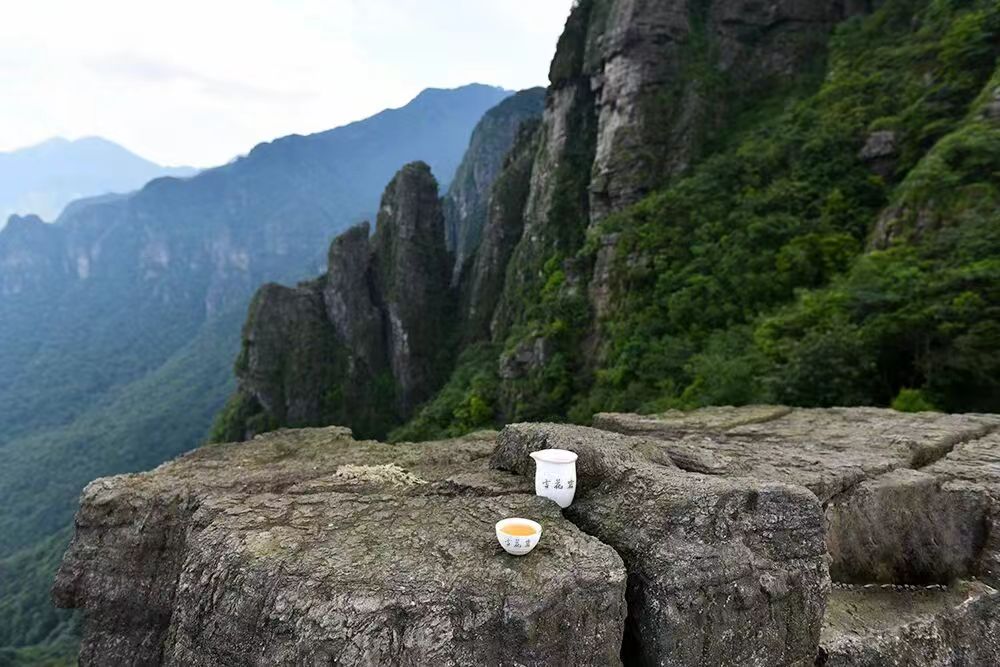
Snow Flower Rock’s tea is not grown. It is found, growing wild on the slopes of Chuandiding (船底顶) and neighboring peaks inside the Luokeng Crocodile Lizard National Nature Reserve — a 32,000-hectare protected forest that is home to two living fossils. One is the crocodile lizard itself, a reptile that has survived unchanged since the age of dinosaurs and is one of China’s first-class protected species. The other is the ancient tea tree.
The forest canopy exceeds 86% coverage. Over thirty peaks rise above 1,000 meters. The temperature on Chuandiding’s upper slopes averages five degrees Celsius lower than the tea gardens below, which delays budding by a full month — wild ancient tree tea on these mountains is not harvested until mid-April, after Qingming, while nearby plantation gardens begin in mid-March. This slower growth cycle concentrates flavor compounds in fewer leaves. The trees’ roots, reaching through mineral-rich rock that has weathered over geological timescales, access nutrients that no plantation bush ever touches.
This is the environment that produces the almond aroma — and it exists in only three ancient tree communities across the entire reserve.
Forty Thousand Ancient Trees, Three That Can Do This
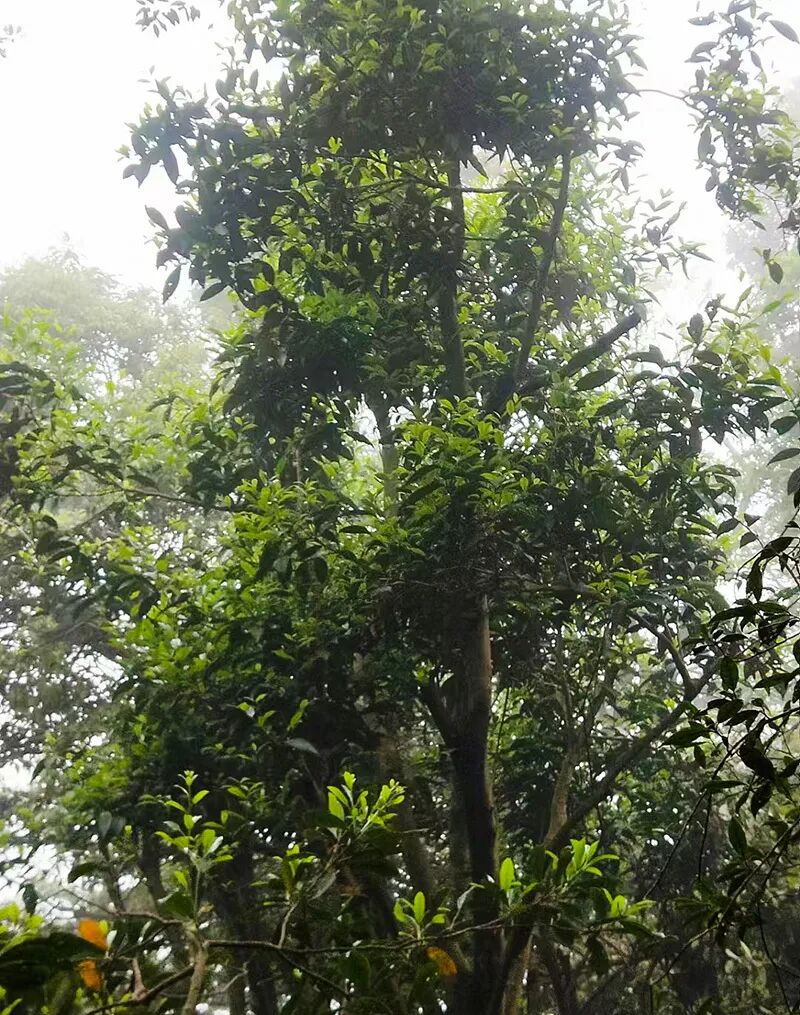
Luokeng’s Nature Reserve has surveyed more than 40,000 wild ancient tea trees over a century old. They are scattered across the mountain, each one growing where its seed fell centuries or millennia ago — accessible only on foot, climbable only by hand. Among these forty thousand, the gushu (ancient tree) population that can produce the almond aroma is confined to exactly three communities.
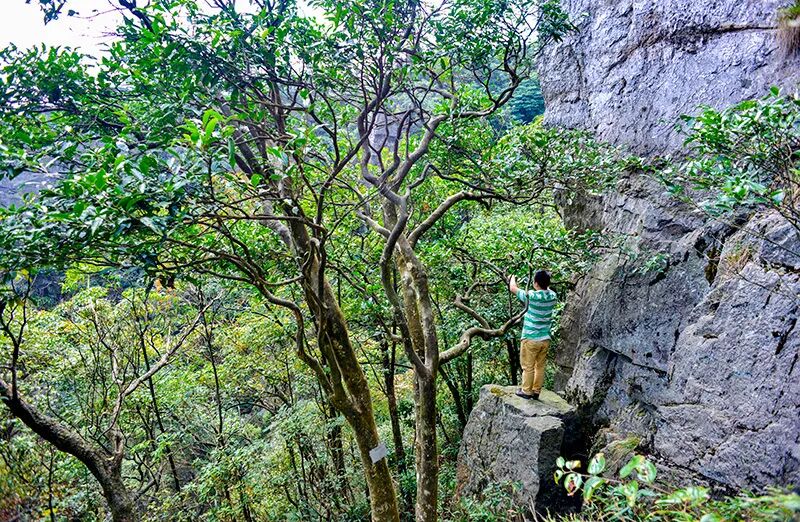
These are not bushes. They are trees that grow 5 to 8 meters tall, with trunks too thick for both arms to encircle, their branches draped in moss and lichen. They produce one flush per year — a single harvest that yields a few hundred grams of finished tea per tree. “It’s not that we limit the quantity,” as the Xuehuayan team puts it. “Nature limits the quantity.” The almond aroma is not a product of scarcity marketing. It is a consequence of genetics, ecology, and geography that cannot be replicated anywhere else.
The Yao People Who Risk Everything for These Leaves
The people who harvest these leaves are the Yao ethnic minority (瑶族) of Luokeng, who have lived in these mountains for centuries. The work begins before dawn — 4:00 or 5:00 AM, with flashlights and woven baskets, hiking trails that are not trails but the forest floor itself. Many of the ancient tea trees grow at the edge of cliffs, on slopes exceeding 80 degrees, reachable only by climbing the trees themselves. A skilled Yao picker can harvest roughly 5 kilograms of fresh leaves in a day — enough to produce perhaps 1 kilogram of finished tea.
On April 23, 2021, a Yao picker at Huajiaoyan (花蕉岩) slipped while picking from a cliffside tea tree and fell, sustaining head and spinal injuries. The rescue took 17 hours — firefighters, outdoor rescue teams, and local volunteers working through a mountain terrain where phone signals barely reach. The picker survived, but the incident illustrated what “wild harvested” actually means. It is not a marketing term. It is a description of risk that very few tea drinkers ever consider.
Xuehuayan, as the company that relies on these pickers, publicly thanked the rescue teams. The accident remains part of the tea’s story — not because it sells tea, but because it tells the truth about where this tea comes from.
The Craft: From Wild Leaves to Bottled Aroma
Tea quality, as the Xuehuayan team describes it, is 70% determined by the raw material and 30% by the processing technique. For wild ancient tree tea, the ratio may be even more skewed toward the source. But that 30% has been the focus of years of refinement led by Li Yuming (李玉明), the Shaoguan master tea craftsman who leads Xuehuayan’s production team, working under Chen Dong’s technical guidance.
The almond aroma presents a unique challenge: it is volatile and easily destroyed by incorrect heat application. The team developed a multi-stage process in which the critical window for fixing (杀青), baking (烘焙), and fragrance development (提香) must be controlled with precision. Get it wrong, and the almond note disappears or turns bitter. Get it right, and the result is a tea that carries the fragrance of the mountain itself — woody, sweet, with the unmistakable note of almond that has no added flavoring.
Chen Dong and Li Yuming’s team also undertook the cultivation of “second-generation ancient trees” (古二代) through selective asexual propagation — preserving the genetics of the three almond-aroma communities while reducing pressure on the wild population. This is not plantation-scale farming. It is conservation-focused cultivation, producing small quantities of tea from trees that trace their lineage directly back to the ancient groves.
The Taste That Defied the Industry
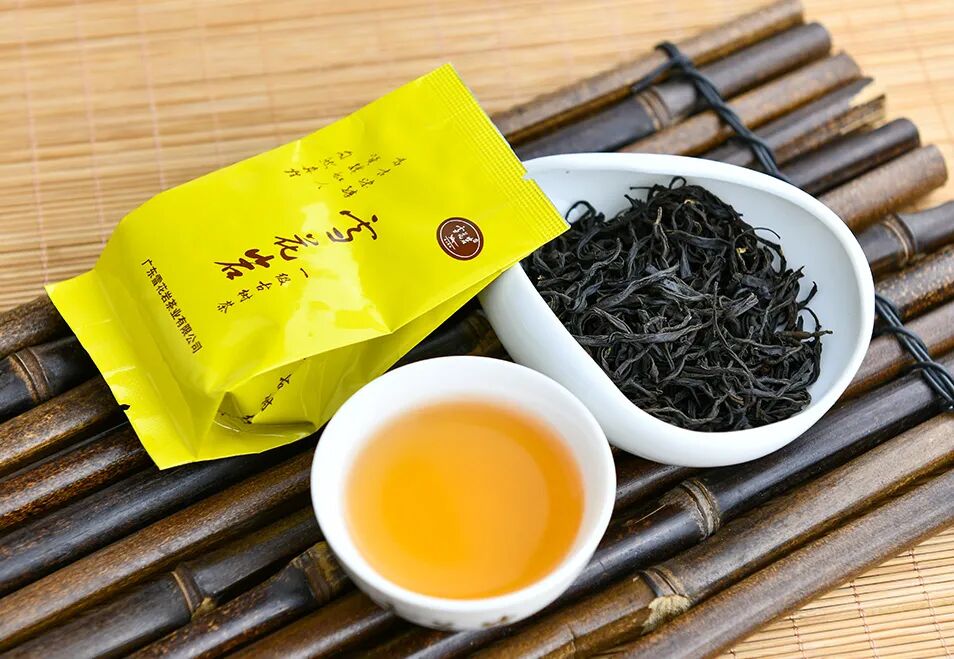
Pour boiling water over the dry leaves, and the fragrance is immediate — not the subtle suggestion of almond that some teas promise, but a clear, natural, identifiable almond note that fills the space around the cup. The tea liquor is a clear amber-gold, warm as honey. The flavor profile is described by Xuehuayan’s team as “木甜杏韵” (mù tián xìng yùn) — woody-sweet almond charm — a mouthfeel that is thick and smooth, with almost no astringency, and a finish that lingers with a cooling sensation in the throat.
The dry leaves are thick, dark, and tightly twisted — the signature of a well-processed ancient tree black tea. Each infusion reveals another layer: the first steep brings the almond and the sweetness; the second brings a deeper woody note with hints of dried fruit; the third settles into a gentle, enduring sweetness that can last through eight or more infusions. This is a tea designed not for a single cup but for an extended session — the kind of tea that reveals more of itself the longer you spend with it.
What makes this remarkable is what is not present: there is no artificial flavoring, no blending, no attempt to imitate a fragrance that nature did not provide. The almond aroma in Snow Flower Rock is entirely natural, a product of the tree’s genetics combined with the specific ecological conditions of the three communities that can produce it — and the proprietary processing technique that preserves it.
What the Price Tells You
The Snow Flower Rock Wild Ancient Tree Black Tea (Almond Aroma) is priced at $650 for its Legend-grade batch — a number that, seen in context, is not arbitrary. Out of 40,000 ancient trees, only three communities can produce this specific tea. The harvest season is one month per year. The pickers risk their safety on 80-degree slopes. The processing technique required years of research by a national expert to perfect. Each batch carries VeriTea Traceability — GPS coordinates of the harvest site, lab analysis, and chain-of-custody documentation that traces every gram back to the mountain.
When you buy this tea, you are not buying leaves. You are buying the accumulated result of a specific genetic lineage, a specific mountain ecology, the expertise of a national-level scientist, the craftsmanship of a master tea maker, and the willingness of Yao pickers to work in conditions that most people would consider too dangerous. That is what $650 represents — and it is visible in every cup.
Explore the Snow Flower Rock Wild Ancient Tree Black Tea (Almond Aroma) on our collection page, where you can trace its origin through VeriTea’s GPS records and learn about the specific batch you are receiving.