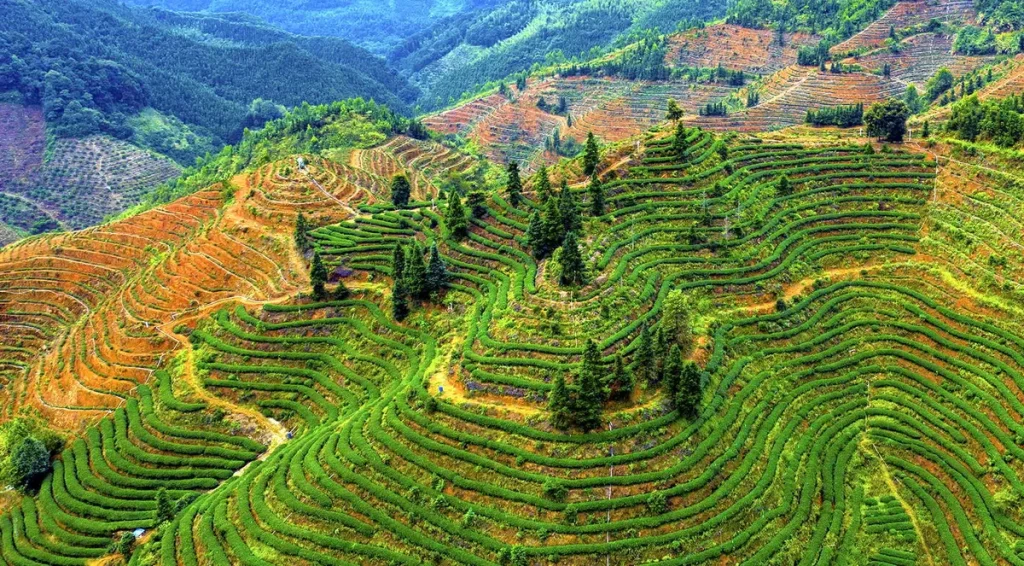
Shaoguan Tea Buyer’s Guide — Find Your Perfect Cup
Northern Guangdong’s Shaoguan region produces some of China’s most distinctive black, green, and white teas — but with dozens of grades, varieties, and price points, finding the right one can be overwhelming. This guide breaks down Shaoguan’s tea spectrum by flavor, occasion, and budget so you can confidently choose your perfect cup.
Whether you’re a seasoned tea collector looking for the rarest ancient tree teas or a curious beginner exploring Chinese black tea for the first time, Shaoguan has something to offer. The region’s five tea-growing districts — Qujiang, Shixing, Lechang, Renhua, and Zhenjiang — each produce teas with distinct personalities shaped by local terroir, cultivars, and processing traditions.
Understanding Shaoguan’s Tea Spectrum
Shaoguan’s tea country spans five districts, each with its own terroir signature. The region is best known for **wild ancient tree black teas**, but it also produces exceptional green and white teas. Here’s what defines each major category:
Wild Ancient Tree Black Tea** — The crown jewel of Shaoguan. Made from leaves of trees 100–800 years old growing in protected nature reserves like Luokeng. These trees have never been planted or pruned by humans — they grow wild in the subtropical forest, their roots penetrating deep into mineral-rich red sandstone soil. The resulting teas deliver complex aromatics — almond, honey-sweet, woody, floral — that no plantation tea can replicate. The best examples come from Xuehuayan (Snow Flower Rock) in Qujiang District.
High-Mountain Organic Black Tea** — Grown on managed organic farms at 600–1,200 meters. These teas come from cultivated bushes (typically Danxia or Baimao varieties) that are tended without synthetic pesticides or fertilizers. Cleaner and more consistent than wild tree tea, with bright sweetness and a mineral finish. Ideal for daily drinking.
Organic Green Tea** — Shaoguan’s green teas are pan-fired in the tradition of northern Guangdong. They offer vegetal freshness with less astringency than many Chinese greens, thanks to the region’s cool misty mornings that slow leaf development and preserve tender amino acids.
White Tea** — A smaller but growing category. Shaoguan white teas use ancient tree buds, producing a honeyed sweetness with minimal oxidation. These are rare finds, typically limited to spring harvest only.
The three most common aroma profiles in Shaoguan black tea are:
- **Almond aroma (杏仁香)** — caused by naturally occurring benzaldehyde, which makes up roughly 40% of the aromatic profile in certain teas. Found only in wild ancient tree teas from the Luokeng area of Qujiang District.
- **Honey sweet (蜜甜香)** — the dominant profile in reserve-grade teas. A rich, caramel-like sweetness with dried fruit notes, similar to longan or lychee.
- **Woody-sweet floral (木甜花香)** — a more subtle, elegant profile with hints of orchid and sandalwood, typically found in high-mountain organic teas.
By Flavor Preference
If You Love Almond / Nutty Flavors 🥜
The **almond aroma black tea** is Shaoguan’s most sought-after and distinctive profile. This is not an added flavor — the almond note develops naturally from a combination of three factors: the specific wild ancient tree cultivar (including the rare Pan-Tao flat peach variety found only near Xuehuayan), the mineral-rich red sandstone soil of the Luokeng Nature Reserve, and the misty highland microclimate at 600–1,200 meters. Scientific analysis has confirmed that benzaldehyde, the same compound that gives bitter almonds their characteristic scent, accounts for approximately 40% of this tea’s aromatic profile.
If you enjoy the nutty complexity of a good Wuyi rock tea or the toasty notes of a high-mountain oolong, the almond aroma tea will likely appeal to you. The experience is unique — a first whiff of the dry leaf smells unmistakably of almond, but the brewed liquor reveals layers of woody sweetness, honey, and a subtle floral finish that lingers in the empty cup.
Best pick:** Snow Flower Rock Wild Ancient Tree Black Tea (Almond Aroma) — XHY-01, Legend grade. $480. The definitive almond aroma experience from 100–800 year old trees, Veritea score 122.
If You Prefer Honey-Sweet Notes 🍯
For a rich, caramel-sweet cup that’s more approachable than the bold almond profile, choose a honey-sweet black tea. These teas offer a smooth, almost syrupy mouthfeel with notes of dried longan, brown sugar, and malt. The sweetness is natural — it comes from the leaf’s amino acid content and the careful oxidation process that converts starches into sugars.
This profile is ideal for tea drinkers who find traditional Chinese black teas too astringent or smoky. The honey-sweet teas are crowd-pleasers — smooth enough for daily drinking, complex enough to hold your attention through multiple infusions.
Best pick:** Snow Flower Rock Reserve Ancient Tree Black Tea — XHY-16, Reserve grade. $85. A honey-sweet, woody-sweet floral black tea that delivers exceptional value for ancient tree quality. Veritea score 123.
If You Like Floral / Delicate Profiles 🌸
Floral tea drinkers should explore Shaoguan’s green teas and lighter black teas. The high-mountain organic green teas offer clean, vegetal notes with a hint of chestnut sweetness. They are pan-fired rather than steamed, giving them a toasty character that distinguishes them from Japanese greens. For black tea lovers who prefer subtle florals, the woody-sweet floral profile is the perfect middle ground — lighter than a typical black tea, with a finish that evokes wildflowers and honey.
Shaoguan’s high-mountain organic green teas offer this delicate profile with clean, vegetal notes and a hint of chestnut sweetness — pan-fired rather than steamed, giving them a distinctive toasty character. Currently between harvests — new season arriving soon.
If You Want Bold / Malty / Full-Bodied ☕
Lechang’s high-mountain Baimaojian black teas deliver bold, malty character with excellent structure. These teas are made from the Lechang Baimao variety — one of China’s first officially recognized improved tea cultivars (certified in 1965) — and are grown on the granite-derived soils of Yanxishan and Jinfeng Mountain. They pair well with milk, making them one of the few Chinese black teas suited to the English-style breakfast preparation.
Best pick:** Lechang Yanxishan Baimaojian Black Tea — available from the Lechang Yanxishan Tea Farm.
By Occasion
Morning Strong Brew
For a bold, full-bodied cup that stands up to breakfast, reach for a reserve-grade ancient tree black tea or a Lechang Baimaojian. Brew it strong — 3g per 150ml at 95°C (203°F) for 3–4 minutes — and you’ll get a deep amber liquor with enough structure to pair with eggs, bacon, toast, or a full English breakfast.
Recommended:** Snow Flower Rock Zen Tea (Wild Ancient Tree Black Tea) — XHY-18, Reserve grade. $98. A bold, woody-sweet brew with excellent depth. Veritea score 113.
Afternoon Gongfu Session
Shaoguan’s premium teas truly shine when brewed gongfu style — small vessel, high leaf-to-water ratio, multiple short steeps. This method reveals the tea’s evolution across infusions in a way that Western-style brewing cannot: the first steep shows the aroma profile, the middle steeps deliver peak flavor and body, and the later steeps reveal subtle sweet notes you’d miss with longer brewing.
Recommended parameters:** XHY-01 brewed gongfu in a 100ml gaiwan with 5g of leaf at 95°C. Rinse for 5 seconds. First steep: 15 seconds. Add 5 seconds each subsequent round. You’ll get 8–10 satisfying infusions. Pay attention to how the aroma shifts — the almond note is strongest in the first 3 steeps, then transitions to honey and floral by steeps 5–7.
Evening Cold Brew
Hot summer evenings call for cold-brewed Shaoguan tea. Place 5g of black or green tea in 1 liter of cold water and refrigerate for 8–12 hours. Strain and serve over ice. The result is a smooth, naturally sweet iced tea with zero bitterness — no sugar needed.
Why it works:** Cold brewing extracts sweet and aromatic compounds while leaving bitter tannins behind. This is especially effective with reserve-grade teas that have high natural sugar content. The honey-sweet profile of XHY-16 produces an exceptionally smooth cold brew. Shaoguan green teas also cold-brew beautifully — use 5g of high-mountain organic green tea for a delicate, floral iced tea that’s perfect for hot afternoons.
Gifts
Shaoguan teas make outstanding gifts for tea enthusiasts. The combination of wild ancient trees, organic certification, and Veritea traceability tells a compelling story that any tea lover will appreciate. For an exceptional gift, choose the XHY-01 Legend ($480) in its presentation box — it arrives with a Veritea certificate detailing the batch’s GPS origin, lab test results, and quality score. For a more modest gift, the XHY-16 Reserve ($85) delivers exceptional quality at a reasonable price point.
By Experience Level
New to Specialty Chinese Tea
Start with an Artisan grade black tea. The **HCH-03 Monkey’s Joy High Mountain Black Tea** ($34) is the ideal entry point — affordable enough that you won’t hesitate to experiment with brewing parameters, but high-quality enough to show you what Shaoguan tea is capable of. Monkey’s Joy offers a well-rounded honey-sweet profile that introduces Shaoguan’s signature terroir without overwhelming the beginner. Brew it Western-style first (3g per cup, 3 minutes at 95°C) to establish a baseline, then try gongfu brewing to taste how the character evolves across multiple steeps.
Intermediate: Exploring Terroir
Once you’ve tasted the core profile, move to Reserve-grade teas. The **XHY-16** ($85) reveals the honey-sweet dimension of Shaoguan black tea — a completely different expression from the almond aroma tea. Compare them side by side: brew both gongfu and note how the XHY-01 delivers concentrated almond and woody notes with a long finish, while the XHY-16 opens with dried fruit and transitions to floral sweetness. This comparison is the fastest way to understand how terroir and cultivar affect flavor in Shaoguan’s wild tree teas.
Advanced: Collector’s Pursuit
The **XHY-01 Legend** ($480) is for the seasoned tea drinker who wants to experience the pinnacle of what Shaoguan’s ancient trees can produce. With a Veritea score of 122, limited annual production, and full traceability to specific trees in the Luokeng reserve, this tea belongs in the same conversation as top-tier Wuyi rock teas and Yunnan ancient tree puerh. It rewards patient gongfu brewing across 8–10 infusions, revealing new dimensions with each steep.
By Budget
Legend & Reserve Tier ($98–$480)
Top-tier wild ancient tree teas from old-growth forests in the Luokeng Nature Reserve. Limited production — each batch is GPS-tracked and Veritea laboratory tested with detailed origin reports.
| Tea | Grade | Price | Flavor Profile |
|---|
|—–|——-|——-|—————-|
| XHY-01 Snow Flower Rock Wild Ancient Tree Black Tea (Almond Aroma) | Legend | $480 | Almond, woody, honey — Veritea 122 |
|---|---|---|---|
| XHY-18 Snow Flower Rock Zen Tea (Wild Ancient Tree Black Tea) | Reserve | $98 | Bold, woody-sweet — Veritea 113 |
Mid-Range / Daily Premium ($12–$85)
High-quality organic teas from carefully managed gardens. Consistent flavor, excellent value for daily drinking.
| Tea | Grade | Price | Notes |
|---|
|—–|——-|——-|——-|
| XHY-16 Snow Flower Rock Reserve Ancient Tree Black Tea | Reserve | $85 | Honey-sweet, woody-sweet floral — Veritea 123 |
|---|---|---|---|
| XHY-09 Snow Flower Rock High Mountain Organic Black Tea (Bag) | Premium | $12 | Entry point organic black tea — Veritea 123 |
Everyday Value (Under $15)
For those new to Shaoguan tea or looking for a daily drinker, the Discovery and Artisan teas offer authentic flavor at accessible prices. The HCH-03 Monkey’s Joy at $34 delivers the core Shaoguan black tea experience — honey-sweet profile with subtle floral notes and a clean finish — at a price that makes daily drinking easy.
How to Read Our Tea Labels
Every Shaoguan tea product carries a set of identifiers that tells you exactly what you’re buying:
Grade Numbers** — Shaoguan tea grades follow the Veritea scoring system, a proprietary quality assessment based on leaf appearance, aroma intensity, liquor color, flavor depth, and aftertaste length. Legend (120+) represents the top tier. Reserve (110–119) offers premium quality. Premium (100–109) is the sweet spot for daily enjoyment. Discovery (90–99) provides an accessible entry point.
Organic Certification Marks** — Look for the China Organic certified seal on the packaging. Xuehuayan teas have been organically certified for 11 consecutive years. Each certified batch undergoes third-party testing for pesticide residues (over 100 compounds screened), heavy metals (lead, cadmium, arsenic, mercury), and microbial contaminants (E. coli, salmonella).
Batch Codes** — Each batch of Shaoguan tea is assigned a unique Veritea code that tracks the tea from leaf to package. Format: `[PRODUCER]-[PRODUCT]-[YEAR][SEASON]`. Example: `XHY-01-2025SP` = Xuehuayan product 01, 2025 spring harvest. You can look up any batch online to see GPS coordinates of the harvest area, processing date, lab test results, and packaging date.
Product Codes** — XHY-series codes identify specific Xuehuayan (Snow Flower Rock) products. XHY-01 is the flagship almond aroma tea. XHY-16 and XHY-18 are reserve-grade black teas. Our green tea offerings are currently between harvest seasons — new crop arriving soon.
Start Your Journey
Shaoguan’s tea world is deep, but you don’t need to be an expert to enjoy it. Start with a flavor profile that matches your preferences, pick a budget that feels right, and use the Veritea traceability system to explore the story behind each cup.
Not sure where to begin?** The HCH-03 Monkey’s Joy High Mountain Black Tea at $34 is the most accessible starting point — it delivers a well-rounded honey-sweet profile that introduces Shaoguan’s signature terroir at a friendly price. If you already know you love complex, rare teas, go straight for the XHY-01 almond aroma — there’s nothing else like it in the world of Chinese black tea.
👉 Browse the full collection at Shaoguan Tea
Still have questions? Read the complete guide to Shaoguan tea for a deeper dive into the region’s history, terroir, and production methods.